
Photo by Bich Tran on Pexels.com
Time management used to be an unquestionable truth to me.
Until I read the book Four Thousand Weeks, by Oliver Burkeman.
Here I will share a bit about the theory of time management, how it migrated from factory lines into our personal lives, and how reading this book challenged what I used to think about time management.
What is Time Management?
According to the Cambridge Dictionary, time management is “the practice of using the time that you have available in a useful and effective way”.
The first documented scientific approach to the topic is the time study led by Frederick W. Taylor in 1881.
His goal was to make workers in factories to become more productive. So he started observing how they worked.
He figured out that by breaking each job into its motions and measuring it with a stopwatch, he could not only identify how long each of these motions was taking but also identify unnecessary ones that could be eliminated.
The results were great: by having the workers follow a machine-like routine that excluded unnecessary motions, the production became much more efficient, resulting in more finished products delivered in a shorter time.

Taylor’s work evolved. In 1911 he published The Principles of Scientific Management.
In the following decades, his work was further developed by Frank and Lilian Gilbreth, who included their psychology knowledge into the mix.
Time-and-motion studies evolved into becoming a core practice of modern production management.
But how did time management spilled over from factory lines to our personal lives?
The legend says that it started in 1918 when the president of a steel company asked a consultant to improve the efficiency of white-collar executives.
The name of this consultant was Ivy Lee. His method – which consisted of writing down every night a list of 6 priorities for the next day and starting from the top the following morning – was considered so successful that it is used to this day.
Lee made great money with this job, and many consultants soon followed his path.
The topic became popular in the late 1950s. Managers saw time management as a way to be more efficient at non-added value work so they could spend more time on worthwhile activities.
Time management left the offices in 1973 when How to Get Control of Your Time and Your Life was published. It sold over 3 million copies.
A new chapter would start with The Seven Habits of Highly Efficient People (1989), which included the importance of spiritual values in decisions on how to make the best use of time.
A whole time management training industry developed after since.
Nowadays, if you google “time management training” you will find around 1 million entries. And Amazon alone shows 60 thousand book titles under the topic time management.
Surprisingly, the original problems that should have been resolved by time management are still out there.
We are overwhelmed by our busy professional and personal agendas and their tight deadlines; at the same time, distractions and procrastination take us away from working toward our goals.
And it gets worse: even after reading piles of time management books and having tried dozens of time management hacks and techniques, we still feel we are not doing enough.
What went wrong?
How Four Thousand Weeks Answers That
This is one of the most insightful books I ever read.
For this post, the most relevant piece is that Burkeman says that the only way to solve our time management problems is to stop pretending that we can get everything by managing time better.
His rationale goes like this:
- Instead of talking about time as “a thing that we can manage”, Burkeman talks about time as part of our existence: “As time passes, we are” (pretty philosophical, huh?)
- Time management hacks and techniques are attractive because they allow us to believe we can achieve everything we want if we plan well.
- But as we try, we fail. No matter how many time management hacks and techniques we use, we still feel overwhelmed by too many tasks and pressing deadlines. Even when we finish the day and have achieved much of our endless to-do lists, we still feel anxious about not having achieved enough.
- The only way to avoid this feeling is to accept that our time on Earth is limited (on average 80 years, or four thousand weeks). And each time we choose to spend our time doing one thing we love/need, we also choose not to use this time in something else that we also love /need.
- By pretending we can have it all if we manage time properly, we keep all options open – we pretend we can have everything.
- The problem is that by doing this, we keep ourselves in this vicious cycle:
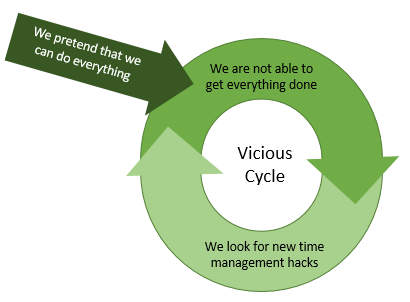
- Burkeman says that the only way to break this painful cycle is by dealing with a different type of pain: the pain of choosing what we will no longer pursue. The pain of closing one door. Or many.

Photo by Bich Tran on Pexels.com
- To minimize the pain of choosing what to let go of, he says that we should be aware that by not choosing we are already making a choice. We are choosing to try to get everything, which is impossible and will always result in feeling frustration and anxiety.
In short, he says that time will pass by in its own rhythm, and we will never have enough time to achieve everything we want.
Accepting our “limit-embracing life” and choosing what we will let go of is the only way to relieve the anxiety that trying to achieve everything brings.
So, what are you going to do with this insight? Purchase the latest time management best-seller? Or accept your “limit-embracing life” and decide what you will not do tomorrow?

